Table of Contents
What Is a Business Growth Plan?
Step 1: Assess Where the Business Stands Today
Step 2: Choose a Growth Strategy Using the Ansoff Matrix
Step 3: Set SMART Growth Goals
Step 4: Set a Primary Revenue Target and Supporting KPIs
Step 5: Build Out the Execution and Resourcing Plan
Business Growth Plan Template
Business Growth Plan Examples
Common Mistakes When Building a Growth Plan
How Cleverly Helps You Hit the Acquisition Numbers Behind Your Growth Plan
Conclusion
Frequently Asked Questions
Modified On :
September 1, 2026
Key Takeaways
- A business growth plan only works when it connects a chosen growth strategy to real resourcing, not just a revenue number on a slide.
- The Ansoff Matrix gives you four growth paths ranked by risk, and most companies should exhaust the lower-risk options before touching the higher-risk ones.
- SMART goals fail when the "Achievable" part gets skipped. A target is only realistic if your team and pipeline can actually support the volume behind it.
- Your growth plan needs 2 to 4 supporting KPIs, not a dashboard of 20 metrics nobody checks.
- The plan itself matters less than the review cadence. Monthly and quarterly checkpoints are what catch a plan going off track before it's too late to fix.
Most business growth plans die the same way. Someone sets a revenue target, builds a nice deck around it, and then nobody checks whether the team has the capacity to actually hit it.
Here's what's happening industry-wide right now: 79% of small businesses expect revenue growth in 2026, projecting an average increase of 7.9%, and 94% of small business owners project growth this year, the highest confidence level ever recorded.
Optimism isn't the problem. Execution is.
Research cited by Harvard Business Review found that 67% of well-formulated strategies fail because of poor execution, and other studies put that number closer to 90%, based on Harvard Business School research from The Balanced Scorecard.
That gap between "we have a plan" and "we hit the plan" is exactly what this guide fixes. You'll walk through a practical framework for choosing a growth strategy, setting goals that actually hold up under scrutiny, and building a plan structure you can revisit every month instead of once a year.
We'll also give you a usable template and real examples, so you're not starting from a blank page.
This guide is built for founders, business owners, and leadership teams who are building a formal growth business plan or refreshing one that's gone stale.
What Is a Business Growth Plan?
A business growth plan is a focused strategic plan tied directly to revenue and market expansion. It's not a general vision statement. It comes with specific strategies, operational requirements, and financial targets, all attached to a defined time horizon.
Here's the distinction that trips people up: a general business plan assumes the business doesn't exist yet. It covers everything from the ground up, including your product, your market, and your funding needs.
A business growth planning document assumes the business already exists. It's not asking "should we start this company." It's asking "how do we scale what's already working."
The part most plans get wrong is stopping at strategy. A real growth plan connects strategy (which growth path you're pursuing) to execution (the goals, the resourcing, and the tracking that actually gets you there).
If your plan is just a strategy memo with a revenue number attached, it's not a growth plan yet. It's a wish list.
🚀 Turn Plans Into Pipeline
Our LinkedIn, cold email, and cold calling campaigns generate 15–30 qualified meetings every month to support your growth goals.
Step 1: Assess Where the Business Stands Today
You can't plan where you're going without knowing where you actually are. Skip this step and you'll build a plan around assumptions instead of facts.
Review Recent Performance
Look at the last 12 months honestly:
- Revenue growth trend: is it accelerating, flat, or slipping?
- Client retention: are you keeping the customers you're winning?
- Profitability trends: is growth actually making you more money, or just more busy?
Run a SWOT Analysis
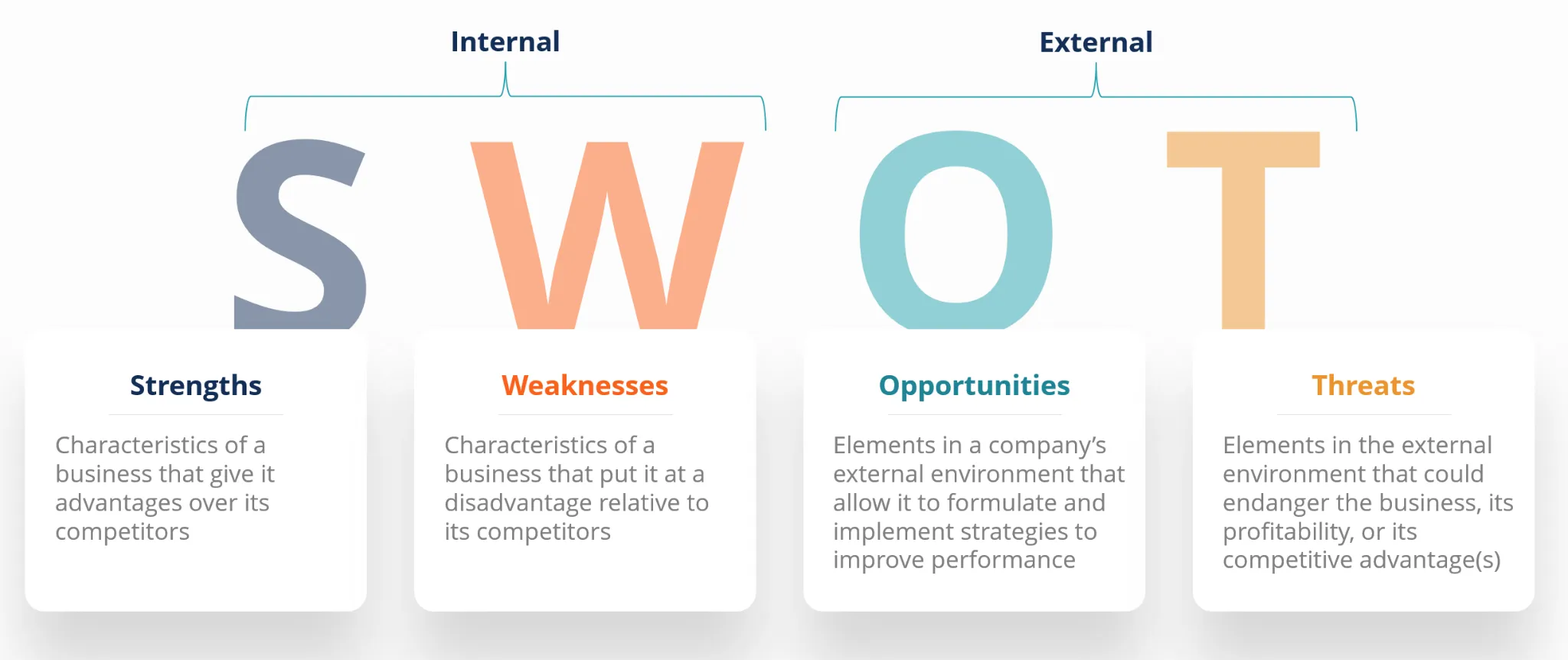
A SWOT analysis (strengths, weaknesses, opportunities, threats) grounds your plan in reality instead of ambition. It forces you to name what's actually working internally versus what you wish were working, and to look outward at where the market is opening up or closing off.
Identify What's Worked and What Hasn't
This is the step people skip most often, and it's the one that costs the most later. If you don't look back at what already worked (and what already failed) before setting new goals, you'll end up repeating the same mistakes with a new coat of paint on them.
Step 2: Choose a Growth Strategy Using the Ansoff Matrix
Once you know where you stand, you need to pick a direction. The Ansoff Matrix is the cleanest way to do this. It maps four growth paths across product and market, and each path carries a different level of risk.
Here's how the four quadrants break down:
Market Penetration (Lowest Risk)
This means growing your market share with the products you already have, in the market you're already in. It's the cheapest and fastest path, because you're not asking your team to learn a new product or a new buyer.
Example: increasing your conversion rate and expanding outreach volume within a customer segment you already know how to sell to.
Market Development
This means taking your existing product into a new market or a new customer segment. You're not changing what you sell, you're changing who you're selling it to.
Example: expanding a proven offering into a new industry vertical or a new geographic region.
Product Development
This means building new products or services for the customer base you already have. Your existing customers trust you, so this path leans on that trust instead of building it from scratch.
Example: adding a new service line that existing customers have already been asking for.
Diversification (Highest Risk)
This means launching new products into entirely new markets. Nothing about this is familiar territory, which makes it the riskiest quadrant by far.
This path should only be pursued after you've genuinely considered and ruled out (or exhausted) the other three. Too many companies jump to diversification because it feels exciting, without asking whether penetration or development would have gotten them most of the way there for a fraction of the risk.
📈 Turn Experience Into Growth
With 53,000+ meetings booked and $312M+ in pipeline generated, Cleverly helps 10,000+ businesses build better buyer journeys and predictable pipeline.
Step 3: Set SMART Growth Goals
A strategic plan for business growth needs goals you can actually act on, not aspirations. The SMART framework forces that specificity.
- Specific: replace "grow revenue" with "increase enterprise contract revenue by 25% in the manufacturing vertical."
- Measurable: attach real numbers, like pipeline value, conversion rates, and new logos acquired.
- Achievable: ground the target in your actual market analysis and current capacity, not an aspirational projection that assumes a team you don't have yet.
- Relevant: every goal should tie directly back to the growth strategy you picked in Step 2. A goal that doesn't connect to your Ansoff quadrant is a distraction.
- Time-bound: set quarterly milestones with monthly checkpoints. Catching a miss in month two is a lot cheaper than catching it in month eleven.
The "Achievable" criterion is the one that gets skipped most often, and it's the one that quietly sinks the most plans. We'll come back to why in Step 5.
Step 4: Set a Primary Revenue Target and Supporting KPIs
Pick one primary revenue or growth target with a specific deadline. Avoid vague ranges like "$1 to $2 million." A range gives you room to miss without noticing.
Once you have that primary target, identify 2 to 4 supporting KPIs that roll up into it and track them monthly:
- Pipeline generated
- Win rate
- Average deal size
That's usually enough. More metrics than that and you end up tracking numbers nobody actually looks at.
Base the target itself on past performance and current market trends, not on a round number that sounded good in a planning meeting. If last year's revenue growth was 12% and nothing structural has changed, setting a 40% target for next year isn't ambition. It's a plan built to fail before it starts.

Step 5: Build Out the Execution and Resourcing Plan
This is where most business growth planning efforts actually break down, and it's directly tied to that "Achievable" checkbox from Step 3.
Map out what resourcing your goals from Steps 3 and 4 actually require:
- Team: do you have enough people to execute at the volume the target implies?
- Budget: is there enough allocated to support the strategy, not just the goal?
- Tools: does your current stack support the execution, or will it become a bottleneck?
Identify capacity gaps early. A growth target that assumes an acquisition volume your current team can't realistically execute isn't a stretch goal. It's a plan risk sitting in plain sight.
Assign clear ownership for each major initiative. "The sales team" owning a goal means, in practice, nobody owns it. A named person with a named deadline is what actually gets initiatives done.
Business Growth Plan Template
You don't need a 40-page document to run this well. Here's a simple, usable skeleton. It's not meant to be exhaustive. It's a starting structure you build on.
Note: You can turn this table into a fillable template and keep it as a living document, not something you write once and file away.
Business Growth Plan Examples
Seeing this applied helps more than another abstract explanation. Here's a business growth plan example for each of the three lower-risk Ansoff paths:
1. Market penetration: a B2B SaaS company increases outbound volume and improves conversion rate within its existing ideal customer profile, targeting a 20% revenue increase without expanding into any new markets.
2. Market development: a services company with a proven offering in one industry vertical expands into an adjacent vertical, using the same core service and the same delivery model that already works.
3. Product development: an agency adds a new service line based on repeated, specific requests from its existing client base, rather than guessing at a new offering the market hasn't asked for.
Notice what each example has in common. It ties back to one specific Ansoff quadrant, and it's measured against a specific, time-bound goal. None of them are general growth aspirations. They're plans someone could actually execute and check progress against next month.
Common Mistakes When Building a Growth Plan
Most growth plans don't fail because the strategy was wrong. They fail because of small, repeatable mistakes made during the planning process itself.
Here's what actually derails a business growth plan in practice, and what to do instead.
❌ Setting a Revenue Target Without Validating Capacity
This is the single most common mistake, and it's the one that does the most damage. A leadership team picks a number that sounds ambitious, like "grow revenue 40% this year," without asking whether the team, budget, and pipeline can realistically support that volume.
Here's why it happens: revenue targets often get set top-down, based on what the board wants to see or what feels competitive, rather than bottom-up from what your current acquisition engine can actually produce. Nobody runs the math on how many new leads, deals, or reps that number actually requires until the plan is already approved.
What this looks like in practice: if hitting your target means closing 50 new accounts and your team closed 20 last year with the same headcount and the same tools, that target isn't a stretch goal. It's a number with no path attached to it.
What to do instead: before finalizing any revenue target, work backward from it. Figure out how many leads, deals, and reps that number actually requires, then compare that against what your current team and systems can produce today. If there's a gap, close it with resourcing, not optimism.
❌ Skipping the Current-State Assessment
Plenty of teams jump straight from "here's where we want to be" to setting goals, without ever really looking at where they are right now. This skips Step 1 entirely, and it's a mistake that compounds quietly.
Without a real assessment of the last 12 months, you have no way of knowing what already worked and what already failed. That means you risk repeating last year's mistakes with a new set of goals stapled on top, since nobody stopped to ask why the last plan came up short.
A common version of this: a company sets an aggressive new-market expansion goal without first checking why retention dropped in its existing market last year. The new goal launches, the same root problem resurfaces, and the plan misses for a reason that was already visible in last year's numbers.
What to do instead: don't skip the SWOT analysis, even when it feels like a formality. Look specifically at what drove your wins and what caused your misses over the past year before you write a single new goal.
❌ Choosing a High-Risk Growth Strategy Before Ruling Out Lower-Risk Paths
Diversification, the highest-risk quadrant in the Ansoff Matrix, is often the most exciting option to pitch in a planning meeting. New products, new markets, a bigger story to tell. It's also the path most likely to fail, since you're asking your team to succeed at something unfamiliar on two fronts at once: an unfamiliar product and an unfamiliar market.
The mistake isn't that diversification is always wrong. It's that teams jump to it before seriously testing whether market penetration or market development could have delivered most of the same growth with far less risk.
What this looks like in practice: a company launches a brand-new product line in a brand-new vertical, while its existing customer base is still under-penetrated and its existing market still has real room to grow. The diversification bet adds risk and cost that a simpler penetration push could have avoided.
What to do instead: work through the Ansoff Matrix in order. Ask honestly whether penetration or development has been genuinely exhausted before diversification even enters the conversation.
❌ Building the Plan Once a Year and Never Revisiting It
A growth plan that gets built in an annual offsite, printed, and then filed away isn't a living plan. It's a snapshot of what leadership believed in January, disconnected from what's actually happening in March, June, or September.
Markets shift. Deals fall through differently than expected. A KPI that looked healthy in Q1 can quietly slip by Q3 if nobody's checking it in between. Without a monthly or quarterly review cadence, none of that gets caught until it's already too late to course-correct within the year.
What this looks like in practice: a company sets a growth plan in January, doesn't look at it again until the year-end review, and discovers in December that a core KPI has been trending down since April. Eight months of correctable drift went unnoticed simply because nobody was checking.
What to do instead: build the review cadence into the plan itself, not as an afterthought. Monthly checkpoints on supporting KPIs and quarterly reviews against the primary goal are what turn a plan from a document into an active management tool.
❌ Treating the Plan as a Strategy Document Instead of an Execution Document
This is the mistake that sits underneath most of the others. A lot of what gets called a "growth plan" is really just a strategy memo with a revenue number attached to the end of it. It says what direction the company is heading, but it never gets specific about who's doing what, by when, or with what resources.
Strategy without an execution layer feels productive to write, but it doesn't actually move anything forward. It's the difference between saying "we're going to expand into a new vertical" and saying "our head of sales owns a 15% pipeline increase in the healthcare vertical by end of Q2, supported by two additional SDR hires and a dedicated outbound budget."
What to do instead: every goal in the plan needs an owner, a deadline, and the resourcing required to hit it. If any of those three pieces is missing, the plan isn't finished yet, no matter how polished the strategy section looks.
How Cleverly Helps You Hit the Acquisition Numbers Behind Your Growth Plan

Most growth plans set an "Achievable" revenue target on paper, but the acquisition volume required to hit it often outpaces what the current team can realistically execute. That gap usually doesn't show up until the quarter's already over and the target's already missed.
We work with companies at exactly this point. As a B2B lead generation agency, our job is to give your growth plan a way to pressure-test that resourcing assumption before it becomes a problem, not after.
Whether your plan calls for market penetration or market development, we provide the outbound execution capacity across LinkedIn, cold email, and cold calling that most internal teams don't have the bandwidth to build and run themselves.
A growth plan is only as strong as its weakest resourcing assumption, and customer acquisition capacity is usually the one nobody stress-tests until the number's already missed.
We've generated $312 million in client pipeline and 224.7K leads for the companies we work with, which is exactly the kind of acquisition volume most internal teams would need years to build from scratch.
If you've set a growth target but you're not confident your pipeline can actually support it, book a strategy call with Cleverly and let's find out where the gap is before it costs you the quarter.
Conclusion
A solid business growth plan combines an honest current-state assessment, a deliberately chosen growth strategy, SMART goals, and a resourcing plan that can actually support them. The Ansoff Matrix gives you a structured way to weigh growth paths by risk before you commit to one, instead of picking the most exciting option and hoping it works out.
None of this holds up without a review cadence. Monthly and quarterly checkpoints are what catch a plan drifting off track while there's still time to fix it.
The biggest risk in most growth plans was never the target itself. It's whether the resourcing behind it, especially customer acquisition, can actually deliver on what the plan promised.
Frequently Asked Questions
Free Resource
How to Scale a Profitable Cold Call System
Get the complete guide — download it instantly now.

Free Ebook
Download the Free Guide
Enter your details to get instant access.
You're all set! 🎉
Your ebook is downloading now.
Click below if the download didn't start automatically.